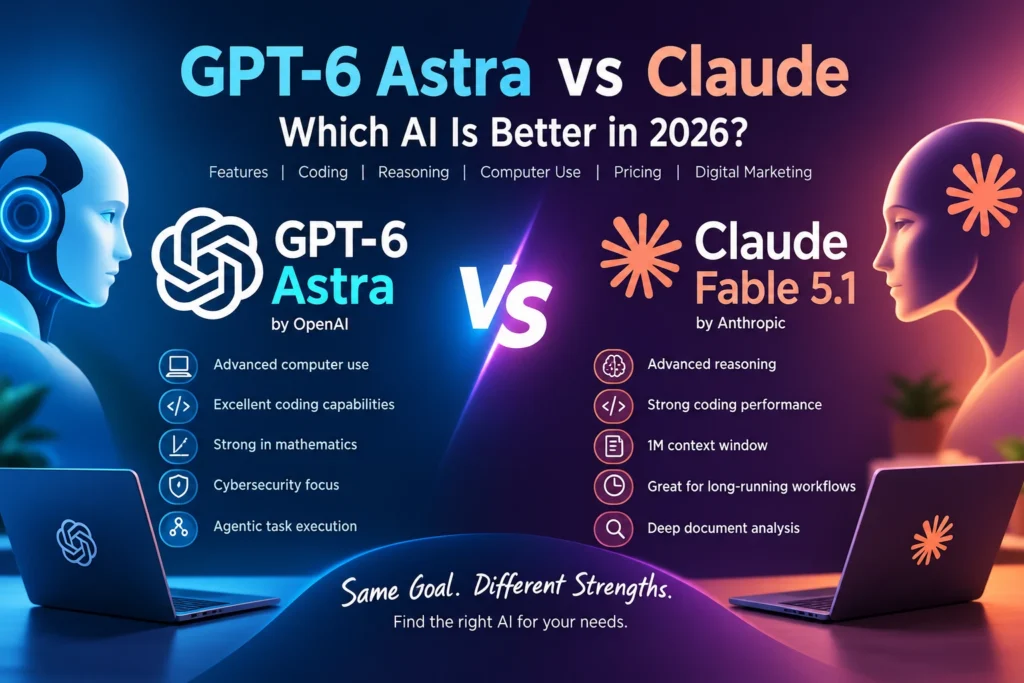
Artificial intelligence has entered another major phase of competition.
OpenAI and Anthropic have both released powerful new frontier AI models, giving users more choices than ever before. On one side is GPT-6 Astra, OpenAI’s latest flagship model. On the other is Claude Fable 5.1, Anthropic’s newest model built for complex reasoning and long-running agentic work.
Both models are designed to go beyond simple chatbot conversations. They can handle coding, research, reasoning, computer-based tasks, large documents, and complex workflows.
So which one is better?
GPT-6 Astra vs Claude Fable 5.1 is not a simple comparison because each model has different strengths.
In this article, we’ll compare them across reasoning, coding, computer use, context window, pricing, and digital marketing to understand which AI model may be better for different users.
GPT-6 Astra vs Claude Fable 5.1: Quick Comparison
| Feature | GPT-6 Astra | Claude Fable 5.1 |
|---|---|---|
| Developer | OpenAI | Anthropic |
| Context window | About 1.05M tokens | About 1M tokens |
| Max output | 128K tokens | 128K tokens |
| Main strengths | Computer use, mathematics, cybersecurity, agentic tasks | Reasoning, long-running workflows, coding |
| Base API price | $10 / 1M input tokens | $10 / 1M input tokens |
| Output price | $50 / 1M tokens | $50 / 1M tokens |
| Computer interaction | Strong | Strong |
| Coding | Excellent | Excellent |
| Long-context work | Excellent | Excellent |
Both models are positioned at the frontier of AI capability, and their published pricing is remarkably similar.
What Is GPT-6 Astra?
GPT-6 Astra is OpenAI’s latest flagship AI model, designed around more agentic and autonomous computer-based work.
Rather than simply answering a question, Astra is designed to perform multi-step tasks and interact with digital environments.
This makes it particularly interesting for:
- Software development
- Research
- Computer automation
- Data analysis
- Professional documents
- Mathematics
- Cybersecurity
- Business workflows
One of Astra’s biggest advantages is its ability to work with computers and software as part of a task.
For example, instead of explaining how to perform a repetitive digital process, an AI agent can potentially carry out the workflow itself.
That represents an important shift from AI that gives instructions to AI that performs tasks.
What Is Claude Fable 5.1?
Claude Fable 5.1 is Anthropic’s latest frontier model, designed particularly for complex reasoning, coding, and long-running agentic workflows.
Claude has built a strong reputation among developers, writers, researchers, and professionals who work with large amounts of information.
Fable 5.1 comes with approximately a 1-million-token context window, allowing it to work with very large documents and extended projects. Recent testing also highlights its ability to maintain context during long-running tasks.
This can be particularly useful when working with:
- Large codebases
- Research documents
- Books
- Business reports
- Complex software projects
- Long conversations
- Large datasets
GPT-6 Astra vs Claude: Which Has Better Reasoning?
This is where the comparison becomes interesting.
There isn’t a single benchmark that proves one model is better at everything.
OpenAI’s published benchmark comparisons show Astra ahead on several mathematical and technical evaluations. For example, OpenAI reports Astra at 97.6% on FrontierMath Tier 4, compared with 87.8% for Fable 5.1.
However, independent testing paints a more complicated picture.
Artificial Analysis’s Intelligence Index gives Claude Fable 5.1 a score of 66 compared with 61 for Astra in the comparison reported by DataCamp. Fable 5.1 also leads on Humanity’s Last Exam with tools.
So the answer isn’t simply:
Astra wins.
or:
Claude wins.
The better conclusion is:
Astra appears particularly strong in mathematics, computer use, and technical agentic tasks, while Claude is extremely competitive in broad reasoning and long-running problem solving.
GPT-6 Astra vs Claude for Coding
Both models are excellent choices for developers.
They can help with:
- Writing code
- Debugging
- Refactoring
- Understanding existing projects
- Creating applications
- Testing
- Reviewing code
- Working with large repositories
Published benchmark results differ depending on the test.
OpenAI’s comparisons give Astra an advantage on several coding and software-engineering evaluations, including DeepSWE. However, independent evaluations show the two models much closer in some coding-agent measurements.
Claude Fable 5.1 also performs strongly on software-engineering benchmarks such as SWE-bench Pro.
Winner for coding?
It’s very close.
For developers who want strong coding plus computer-use capabilities, Astra may be particularly attractive.
For developers who value deep code review, reasoning through an existing project, and long-running development workflows, Claude may be the better fit.
GPT-6 Astra vs Claude for Computer Use
This is one area where Astra has a particularly strong case.
Astra is designed to interact with computer environments and perform multi-step digital tasks.
This could allow users to move beyond:
“Tell me how to do this.”
toward:
“Do this for me.”
That distinction could become extremely important as AI agents become more capable.
Imagine asking an AI to:
- Research competitors
- Collect information
- Organize the findings
- Create a spreadsheet
- Prepare a presentation
- Summarize the results
Instead of requiring the user to manually complete every step, the AI can potentially perform much of the workflow.
Astra’s computer-use capabilities are one of the areas where recent comparisons give it an advantage.
Which Has the Larger Context Window?
Both models offer extremely large context windows.
GPT-6 Astra is reported at approximately 1.05 million tokens, while Claude Fable 5.1 offers approximately 1 million tokens.
In practical terms, this means both can work with very large amounts of information.
For example, users can potentially provide:
- Large reports
- Extensive documentation
- Large codebases
- Multiple research papers
- Long project histories
The small difference in context size is unlikely to be the deciding factor for most everyday users.
The more important question is how effectively the model uses that context.
GPT-6 Astra vs Claude: Which Is More Affordable?
Interestingly, both models have similar headline API pricing.
Current comparison data reports:
GPT-6 Astra
- $10 per million input tokens
- $50 per million output tokens
Claude Fable 5.1
- $10 per million input tokens
- $50 per million output tokens
However, their actual costs can differ depending on caching, context length, and how many tokens are required to complete a task.
This is an important lesson:
The cheapest price per token does not necessarily mean the cheapest AI model to run.
A model that completes a task using fewer tokens may ultimately cost less.
Which AI Is Better for Digital Marketing?
This is where the comparison becomes especially interesting for marketers.
AI is rapidly becoming part of SEO, content marketing, social media, advertising, analytics, and research.
Both Astra and Claude can potentially help digital marketers with:
SEO
AI can assist with:
- Keyword research
- Content planning
- Competitor research
- SEO audits
- Content briefs
- Meta descriptions
- Internal linking ideas
- Search-intent analysis
Content Marketing
Both models can help create:
- Blog outlines
- Articles
- Social media captions
- Email campaigns
- Website copy
- Content calendars
- Ad copy
But marketers should avoid publishing AI-generated content without review.
Good marketing requires originality, brand understanding, accurate information, and a human perspective.
Social Media Marketing
AI can help marketers develop:
- Content ideas
- Instagram carousel concepts
- Reels scripts
- Campaign themes
- Captions
- Audience research
- Engagement strategies
Marketing Research
This is where agentic AI could become particularly useful.
A marketer could potentially ask an AI to research competitors, collect information, analyze patterns, and turn the results into a marketing report.
That can save significant time.
For professionals positioning themselves as a Best Digital Marketer in Ernakulam, understanding how to combine AI tools with human marketing strategy could become an important competitive advantage.
Which Is Better for Businesses?
Businesses should not necessarily choose an AI model based on benchmark scores alone.
Instead, consider the actual workflow.
Choose GPT-6 Astra if you need:
- Advanced computer use
- Complex mathematical reasoning
- Technical research
- Cybersecurity-related capabilities
- Agentic workflows
- Professional document creation
- Strong automation capabilities
Choose Claude Fable 5.1 if you need:
- Long-form reasoning
- Large-context analysis
- Complex code review
- Long-running projects
- Deep document analysis
- Strong reasoning-focused workflows
These aren’t absolute rules. Both models are capable across most of these categories.
GPT-6 Astra vs Claude: Which One Should You Choose?
There is no universal winner.
If your priority is computer interaction, mathematical reasoning, automation, and agentic execution, GPT-6 Astra is an extremely strong choice.
If your priority is deep reasoning, large-context work, coding, and long-running projects, Claude Fable 5.1 is equally compelling.
And benchmark results should always be interpreted carefully.
OpenAI’s own benchmarks favor Astra in many categories, while independent evaluations have found Claude ahead in some overall intelligence measures.
That means the best AI model is ultimately the one that performs best for your specific workflow.
The Bigger Question: Are AI Models Becoming AI Employees?
Perhaps the most important part of this competition isn’t which model scores higher.
It is the direction AI is moving.
Older AI tools mainly helped people generate information.
Modern AI agents are increasingly designed to:
Understand → Plan → Use tools → Execute → Evaluate
That changes the relationship between humans and AI.
A marketer may no longer need to manually perform every repetitive task.
A developer may not need to write every line of code.
A business owner may be able to delegate portions of digital workflows to AI.
Humans will increasingly focus on:
- Strategy
- Creativity
- Decision-making
- Brand direction
- Critical thinking
- Customer relationships
AI can handle more of the execution.
Frequently Asked Questions
Is GPT-6 Astra better than Claude Fable 5.1?
There is no universal winner. Astra performs strongly in computer use, mathematics, and several technical benchmarks, while Claude Fable 5.1 leads some independent reasoning evaluations.
Which is better for coding, Astra or Claude?
Both are excellent for coding. Astra has strong results on several agentic coding benchmarks, while Claude Fable 5.1 is also highly competitive for software engineering and code-focused workflows.
Which AI is better for digital marketing?
Both can assist with SEO, content, research, advertising, and social media. The better choice depends on your workflow rather than simply choosing the model with the highest benchmark score.
Is GPT-6 Astra more powerful than Claude?
Astra is more capable in some areas, while Claude is stronger in others. Current benchmark results do not support a simple “Astra is better at everything” conclusion.
Which AI should businesses use?
Businesses should test both models against their actual workflows. Factors such as accuracy, cost per completed task, automation capability, security, and integration with existing tools are often more important than benchmark scores alone.
Conclusion
The GPT-6 Astra vs Claude Fable 5.1 competition shows how quickly AI is evolving.
Both models represent a move toward AI systems that don’t simply answer questions but can reason through complex problems, work with large amounts of information, write software, use tools, and complete multi-step tasks.
Astra has a particularly strong position in computer use, mathematics, and agentic execution.
Claude Fable 5.1 remains highly competitive in reasoning, coding, and long-running workflows.
So, which one wins?
There isn’t one winner for everyone.
The real winner is the user who understands the strengths of each model and chooses the right AI for the right job.
And for digital marketers, developers, entrepreneurs, and businesses, that may be the most important skill of all:
Don’t just use AI. Learn how to use the right AI for the right task.
Author info
Muhammed Raizal is a Digital Marketer in Ernakulam specializing in SEO, social media marketing, Google Ads, content marketing, and website development. He helps businesses build a stronger online presence and turn digital strategies into measurable growth.